Meridian Urban Metrics
A forward-deployed engineering platform for real-estate development and investment analysis. The Meridian model is a reusable historical data and modeling layer that can be used to evaluate underwriting, site-selection, portfolios, and development decisions.
Summary
Building an empirical record of development
I designed a shared data model connecting property transactions, financing, permits, parcels, buildings, distress, and market context over time. New York City is the first implementation, with the underlying structure designed for other U.S. markets.
Turning fragmented records into project histories
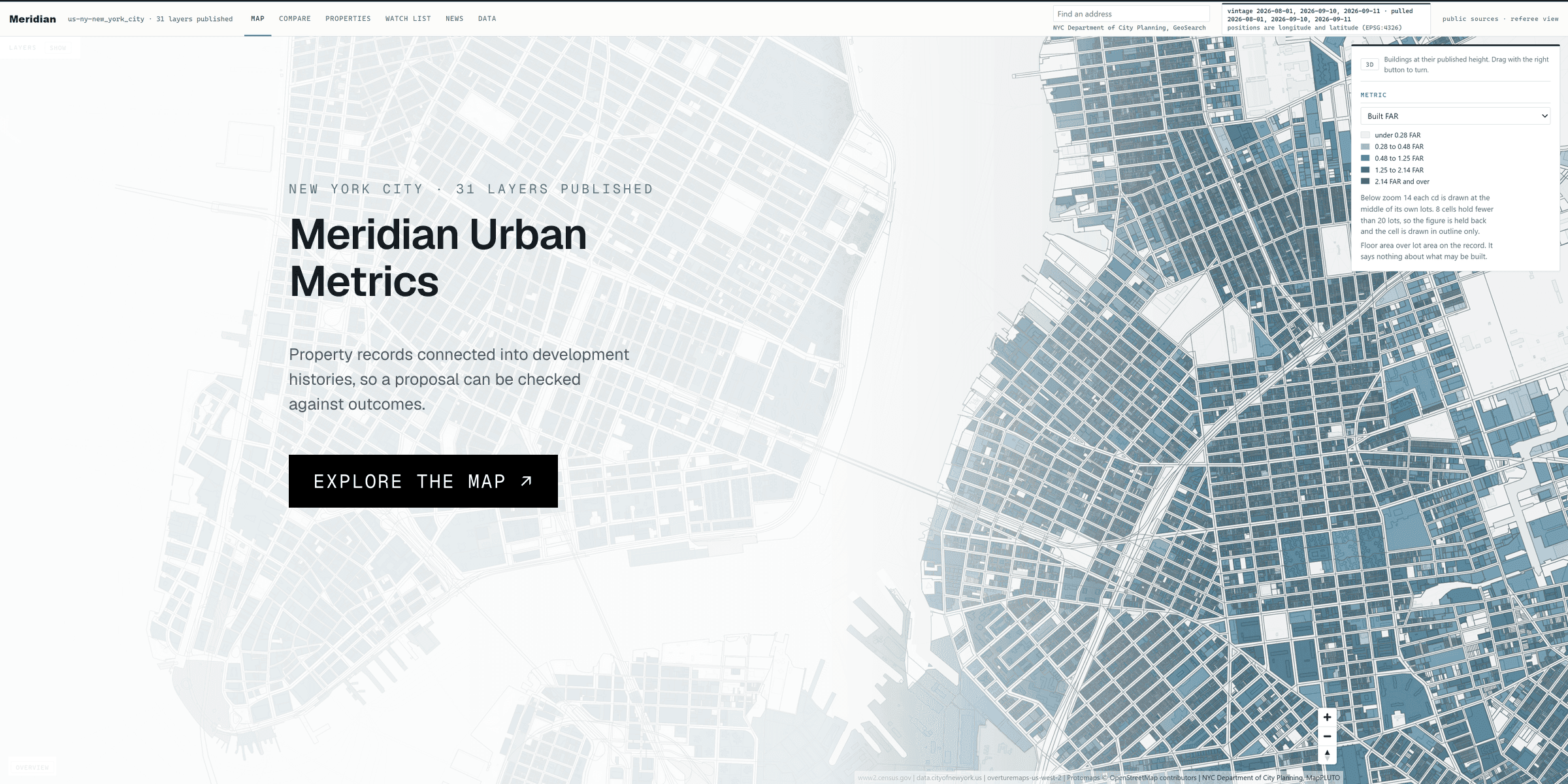
The pipeline combines 27 public datasets and millions of records into longitudinal development episodes. An initial cohort of approximately 24,000 multifamily projects is being reconstructed and validated from acquisition through financing, construction, ownership, sale, or distress.
Deploying the system into real decisions
Meridian is built as the common technical layer for forward-deployed work. Client portfolio data, underwriting assumptions, or development pipelines can be connected to the historical system to build decision-specific analyses, models, interfaces, and workflows. Repeated requirements can then become reusable product capabilities.
Description
Context
An answer key for development decisions
Real-estate decisions depend on assumptions about rents, financing, approvals, construction, and eventual value, yet the evidence needed to test those assumptions is fragmented across separate systems. Meridian reconstructs that history so a lender, developer, or investor can compare a new decision with what happened to similar projects under similar conditions.
The underlying problem is temporal entity resolution. Parcels split and merge, buildings change, ownership structures evolve, and many transactions or permits can belong to one development. Meridian preserves dates, provenance, and historical identity so past projects can be reconstructed without treating today’s property record as if it always existed.
Approach
Product infrastructure for forward-deployed work
I built a canonical schema and ingestion pipeline that translates source-specific records into a consistent model of properties, projects, financing, construction, context, and outcomes. That shared infrastructure can then be deployed around a client’s particular question instead and used for all consulting engagements.
The plan is to use the consulting work to update and refine the model: deployments expose missing data, weak abstractions, and recurring workflows, while general solutions will become part of the core platform.
Models are designed around point-in-time correctness so a historical prediction only uses information available when the original decision was made. The same system supports predictive work and separate causal studies, beginning with the 2005 Greenpoint-Williamsburg rezoning.
Deliverables
A reusable evidence and engineering layer
The current system includes a working data pipeline, DuckDB warehouse, provenance and audit tooling, geospatial viewer, approximately 24,000 development histories under validation, a causal-research framework, and an analysis of 445 construction-loan agreements.
Rather than producing one fixed dashboard, Meridian provides reusable infrastructure for client-specific underwriting tools, portfolio analysis, site search, market studies, models, and workflow integrations.
The warehouse currently contains approximately 4.3 million deed rows, 4.7 million mortgage instruments, 2.4 million permit filings, and 192,000 distress filings. The analytical layer is designed to estimate multiple project outcomes and uncertainties rather than collapse every decision into a single risk score.
More projects
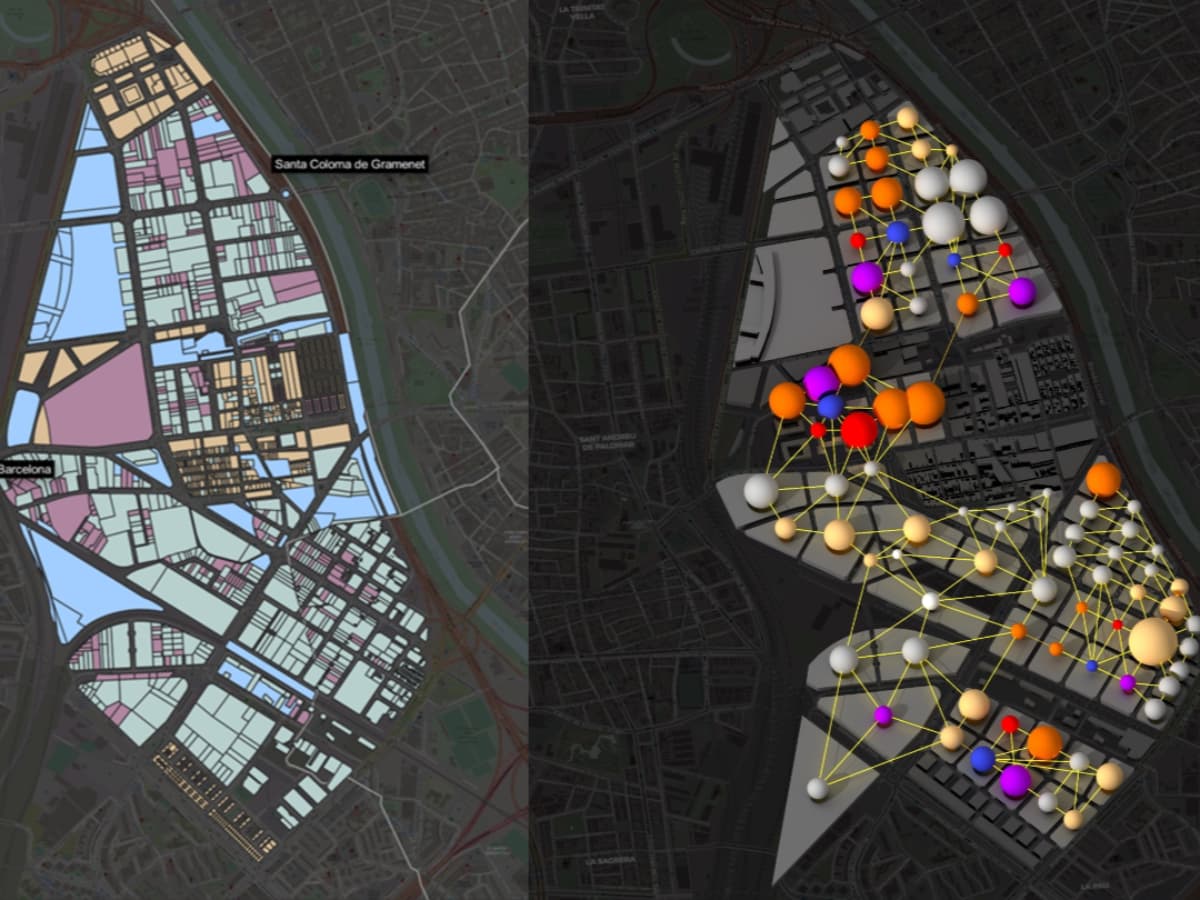
Designing Innovation Districts
Three connected analyses, covering economic complexity, research-network graphs, and urban form, combined into one innovation pipeline and a buildable district design.
Data · Urbanism · Economics · 2022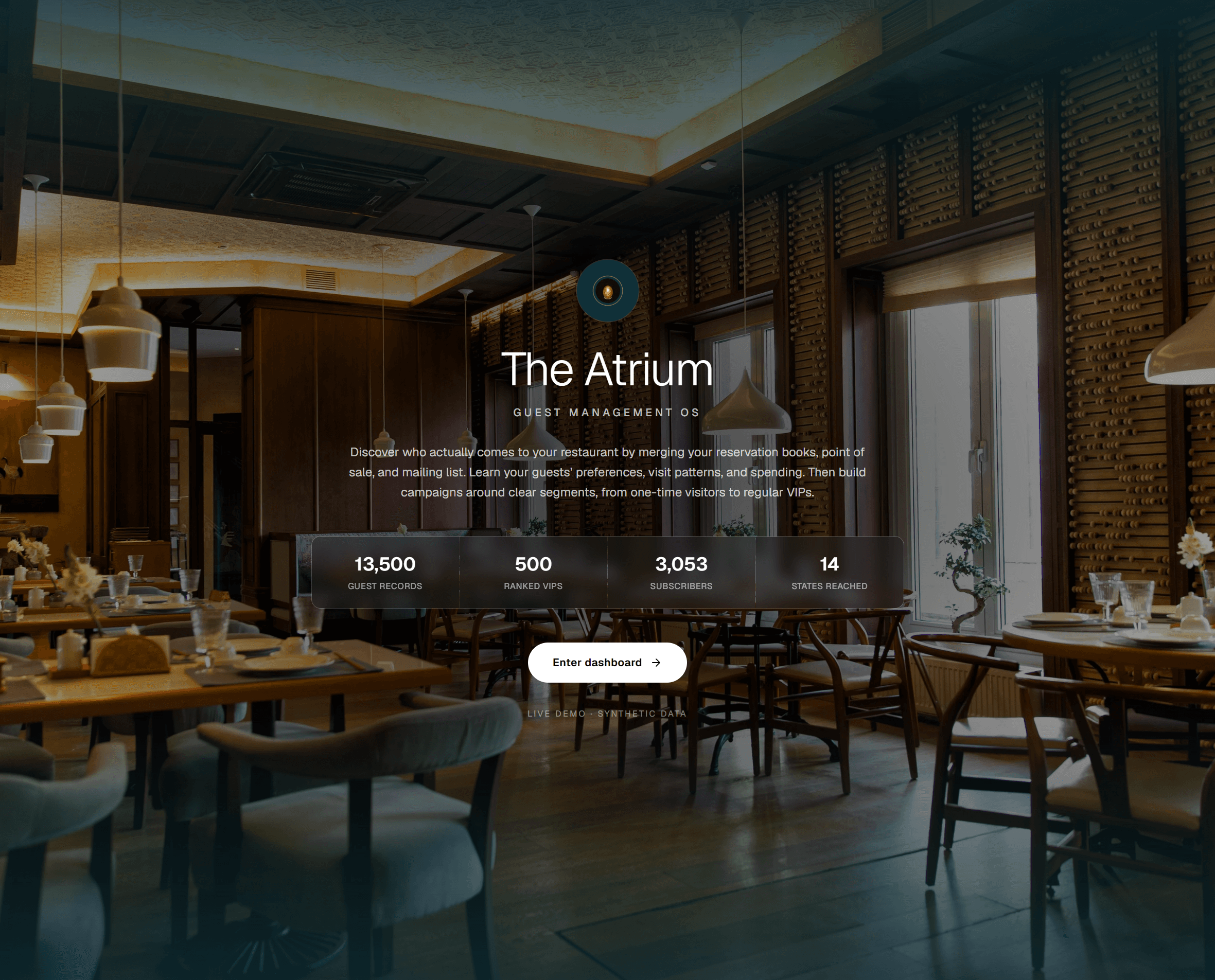
Guest Intelligence Dashboard
A five-day onsite sprint merging 44,874 guest records from four disconnected systems into a single source of truth, with a dashboard to read guest profiles.
AI · Business · 2026